|
|
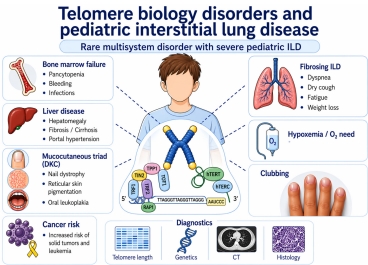
Question: What are the pulmonary manifestations and clinical characteristics of telomere biology disorders in children with interstitial lung disease? Finding: Telomere biology disorders are an important but often underrecognized cause of childhood interstitial lung disease and are associated with variable pulmonary, radiologic, and histopathologic findings, frequent multisystem involvement, and often severe disease progression. Meaning: Early genetic testing and multidisciplinary evaluation are essential for timely diagnosis, optimized management, and improved outcomes in affected children. |
|
|
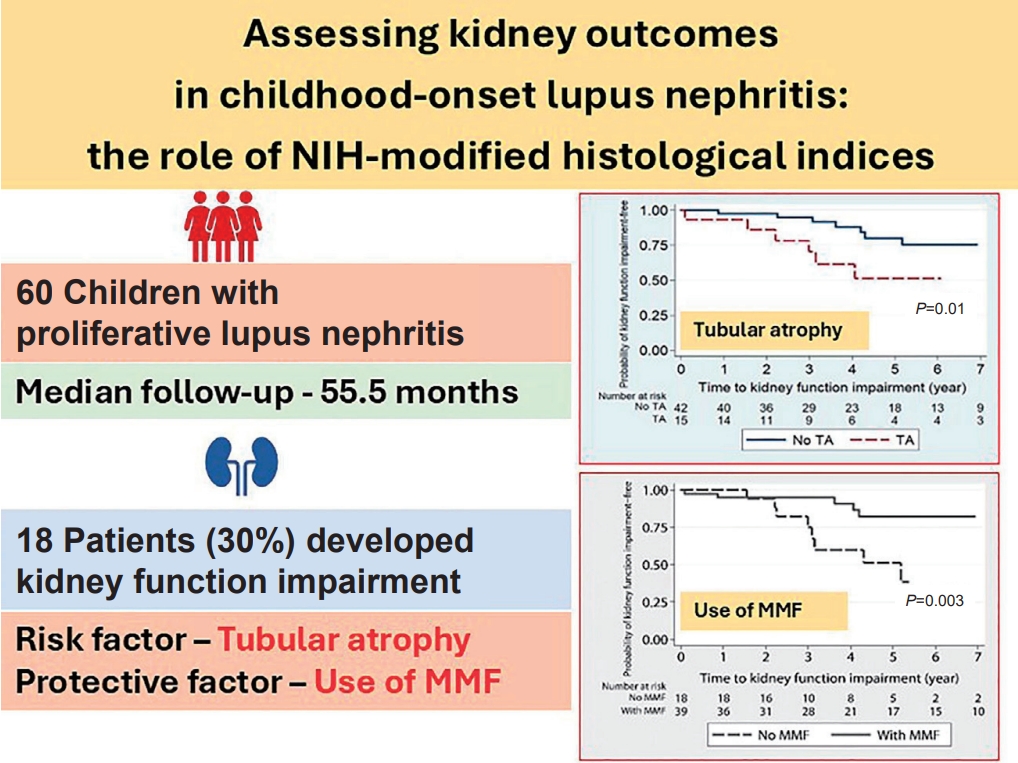
Question: In children with proliferative lupus nephritis, do National Institutes of Health-modified indices and treatment choices predict long-term kidney function? Finding: Higher chronicity index scores, especially tubular atrophy and interstitial fibrosis, predicted kidney impairment. Additionally, the use of mycophenolate mofetil (MMF) for maintenance therapy was associated with a lower risk of kidney function decline. Meaning: The early recognition of chronic lesions and MMF-based maintenance therapy may improve kidney outcomes in childhood-onset lupus nephritis. |
|
|
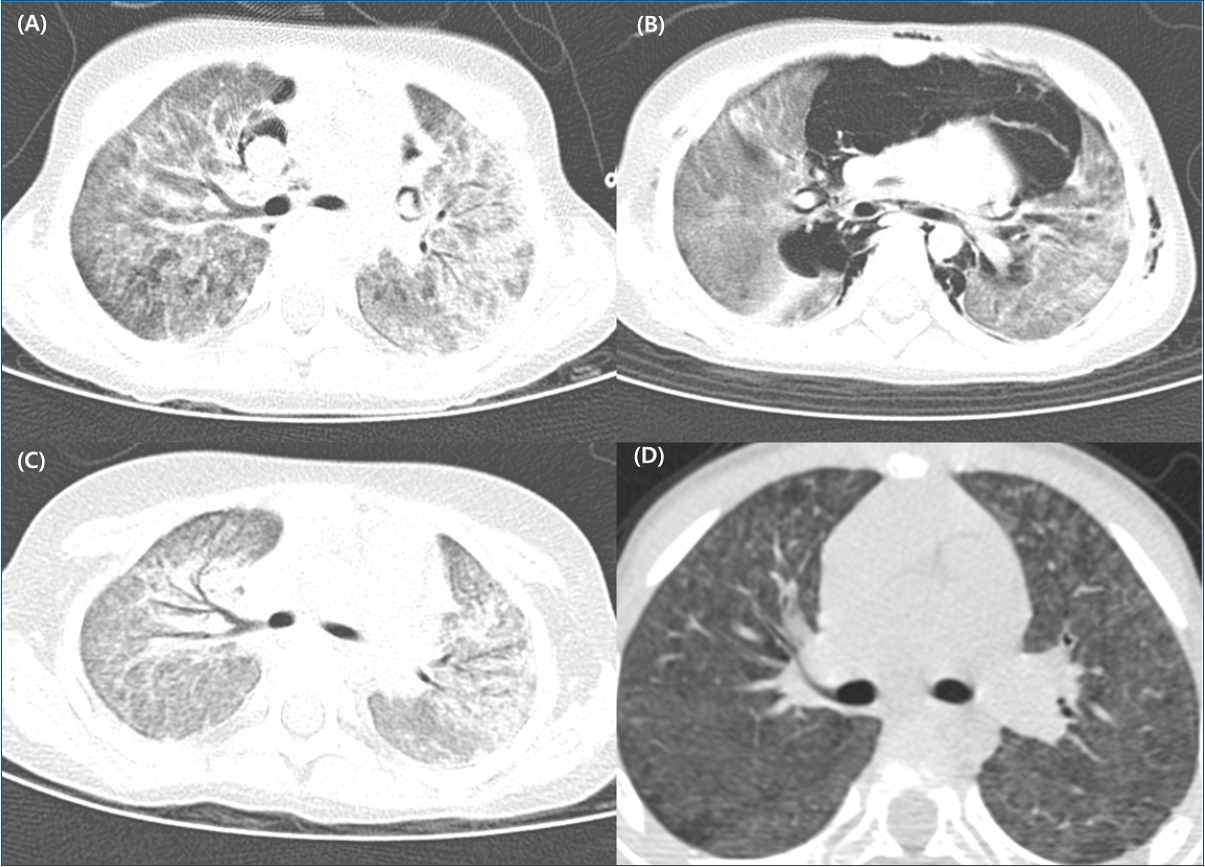
Exposure to environmental factors can cause interstitial lung diseases (ILDs); however, such types of ILDs are rare. From 2007 to 2011, an ILD epidemic occurred in South Korea owing to inhalational exposure to toxic chemicals in humidifier disinfectants (HDs). HD-associated ILDs (HD-ILDs) are characterized by rapidly progressing respiratory failure with pulmonary fibrosis and a high mortality rate of 43.8%−58.0%. Although... |
|
Tubulointerstitial nephritis and uveitis (TINU) syndrome is a rare disease, often underdiagnosed or misdiagnosed in children. We describe the case of a 12-year-old boy who presented to Severance Hospital with a 1-month history of bilateral conjunctival injection. He was first evaluated by an Ophthalmologist in another hospital and diagnosed with panuveitis. Laboratory tests indicated renal failure, and a renal biopsy... |
|
Interstitial deletions involving the chromosome band 15q22q24 are very rare and only nine cases have been previously reported. Here, we report on a 12-day-old patient with a |
|
The Epstein-Barr virus (EBV) is oncogenic and can transform B cells from a benign to a malignant phenotype. EBV infection is also associated with lymphoid interstitial pneumonia (LIP). Here, we report the case of a 14-year-old boy who was diagnosed with a latent EBV infection and underlying LIP, without any associated immunodeficiency. He had been EBV-seropositive for 8 years. The... |
| Purpose : Acute interstitial pneumonia (AIP) is a rare disease, but its prognosis is fatal because of lack of efficient treatment modality. Recently, it has been reported that there was epidemic AIP in Korea. This study aims to investigate the past and current status of AIP in Korea. Methods : We performed a nationwide survey and a prospective study. From August... |
| Purpose : Pulmonary interstitial emphysema (PIE) primarily occurs in preterm infants suffering from respiratory distress syndrome (RDS) and kept under mechanical ventilator care. Therefore, this study aimed to examine various risk factors for PIE, to identify conditions that can decrease the possibility of PIE development. Methods : PIE classification was conducted for 183 patients diagnosed to have RDS and receiving mechanical... |
| Purpose : This study was aimed to analyze the clinical characteristics of patients with acute interstitial pneumonia who had presented similar clinical patterns from March to June, 2006 and to describe our experience of treatment and to identify risk factors associated with prognosis. Methods : The clinical characteristics, radiologic and histopathologic findings and response to steroids of 15 patients (non-survival... |
| Interstitial lung disease refers to a group of pulmonary disorders characterized by inflammation of the interstitium, derangements and loss of alveolar capillary units leading to disruption of alveolar gas exchange, which induces symptoms of restrictive lung disease. Cases of interstitial pneumonia in children are uncommon and mostly have unknown causes. We have experienced an 8-year old boy who had symptoms... |
| Department of Pediatrics†, College of Medicine, Korea University, Seoul, Korea Interstitial pneumonia is a heterogenous group of inflammatory and fibrosing lesions that manifest themselves as infiltrative lung disease. Of these, nonspecific interstitial pneumonia is characterized as a variable degree of interstitial inflammation with or without fibrosis and is distinguished from usual interstitial pneumonia and desquamative interstitial pneumonia, histologically. The influx of... |
| Syndrome of 4q deletion is characterized by an abnormal shape of the skull, craniofacial dysmorphism, cardiovascular malformations, genitourinary defects, limb and digital anomalies, and developmental delay. We experienced a case of 4q interstitial deletion in a 2 day-old female neonate who showed short extremities, partial agenesis of corpus callosum and congenital heart defects. We report the case with a brief... |
| Purpose : Interstitial lung disease(ILD) is a rare and poorly characterized disorder in children with poor prognosis. To understand the ILD in children, we reviewed our experience with 21 patients who were diagnosed interstitial lung disease during 9-year period at Asan Medical Center retrospectively. Methods : Severity-of-illness score was measured by the Denver protocol. We evaluated underlying diseases, clinical manifestations, high resolution computed tomography findings,... |
| The interstitial lung diseases(ILD) comprises a large, heterogeneous group of disorders characterized by derangement of alveolar walls and alveolar capillary unit causing restrictive pulmonary dysfunction and disordered gas exchange. It is rare, especially in children, and the opinions on investigation and treatments are controversial. The classification of adult ILD is applied to that of children. But considering occurrence during the developing state of lung... |
| This is the first reported case of a unique interstitial deletion involving the long arm of chromosome 17 in a Korean male infant born to parents with normal karyotype. The patient presented with multiple congenital malformations suggestive of chromosomal anomaly including round face, upslanted palpebral fissure, hypertelorism, posteriorly rotated low set ear, micrognathia, microcephaly, finger- like thumb, bilateral hearing loss,... |
| Lymphoid interstitial pneumonia(LIP) is an uncommon process in childhood, and is characterized by interstitial accumulation of mature lymphocytes, plasma cells and reticuloendothelial cells. LIP is believed to have autoimmune or immunologic pathogenesis, because it is frequently associated with acquired immune deficiency syndrome, Epstein-Barr virus infection, common variable immunodeficiency. The patient described in this report had idiopathic thrombocytopenic purpura, Evans syndrome... |
| Purpose : Pulmonary interstitial emphysema(PIE) is a common and serious complication of mechanical ventilation in infants with hyaline membrane disease. This abnormal collection of gases has two basic roentgenographic features; linear and cyst-like radiolucencies. High positive inspiratory pressure was found to be the most significant parameter associated with development of fatal pulmonary interstitial emphysema. Without prompt conservative management such as lowering peak inspiratory... |
| Authors recently experienced a case of acute interstitial nephritis associated with Yersinia pseudotuberculosis infection in 10-8/12 year old boy, who was admitted to prolonged high fever. On 3rd hospital day, puffy face and oliguria were noted. BUN and serum creatinine rose to peak level, 94.1 mg/dl and 10.1 mg/dl, respectively on 7th hospital day. After then renal functions were normal- ized gradually without specific... |
| We observed 42 cases of neonates, who were diagnosed as having Hyaline membrane disease and had been received mechanical ventilation in neonatal intensive care unit of Presbyterian medical center from July 1984 to July 1988. In order to observe the factors associated with pneumothorax, we devide these cases in two groups. First group was consists of infants with pneumothorax, second group was consists of... |
| Desquamative interstitial pneumonia (DIP) is a variant of idiopathic interstitial pneumonias, but characteristicalIy has massive desquamation and proliferation of alveolar cells into the distal air space with minimal fibrosis of the alveolar wall. DIP seems to have better response to corticosteroid and benign prognosis than idiopathic interstitial pneumonia. We experienced one case of 6-year old girl who showed typical picture of DIF on lung... |
| Interstitial pneumonitis is a rare, diffuse lung disease characterized by varing combinations of two histological features: thickening of alveolar walls and the presence of large mononuclear cells in the alveolar spaces. 4 cases with interstitial pneumonitis, admitted to the Pediatric Department of Seoul National University Hospital during the period from Jan. 1979 through. May, 1985 were reviewed clinically. The results... |
| A retrospective review was performed of 15 medical records to study the pneumomedia- stinum in the newborn during last 4 years from Jan. 1980 through Dec. 1983 at Severance Hospital of Yonsei University. Tne results were as follows: 1) The incidence was 0.14% (15 of 8,737 live-births) during the neonatal period. Of those cases spontaneous pneumomediastinum was 66.7%(10 cases) and secondary pneumomedia- stinum 33.3%(5 cases). Males were... |
| Clinical records of 25 neonates with secondary pneumothorax were reviewed retrospectively during last 6 years from Jan. 1978 through Dec. 1983 at Pediatric Department of Yonsei University Hospital. The following results were obtained; 1)The incidence of secondary pneumothorax was 0.16% (21 out of 12,864 live-birth) during the neonatal period. The incidence tended to increase since we had set up the neonatal,... |
Clinical and Experimental Pediatrics is an open access journal. All articles are distributed under the terms of the Creative Commons Attribution NonCommercial License (http://creativecommons.org/licenses/by-nc/4.0/)
Copyright © 2026 by Korean Pediatric Society.