- Original Article
- Neonatology (Perinatology)
- Respiratory severity score-guided postnatal systemic corticosteroid therapy for bronchopulmonary dysplasia in extremely preterm infants
-
Gyeong Eun Yeom, Ju Sun Heo, Baek Sup Shin, Seh Hyun Kim, Seung Han Shin, Ee-Kyung Kim, Han-Suk Kim
-
Clin Exp Pediatr. 2025;68(9):656-665. Published online July 8, 2025
-
|
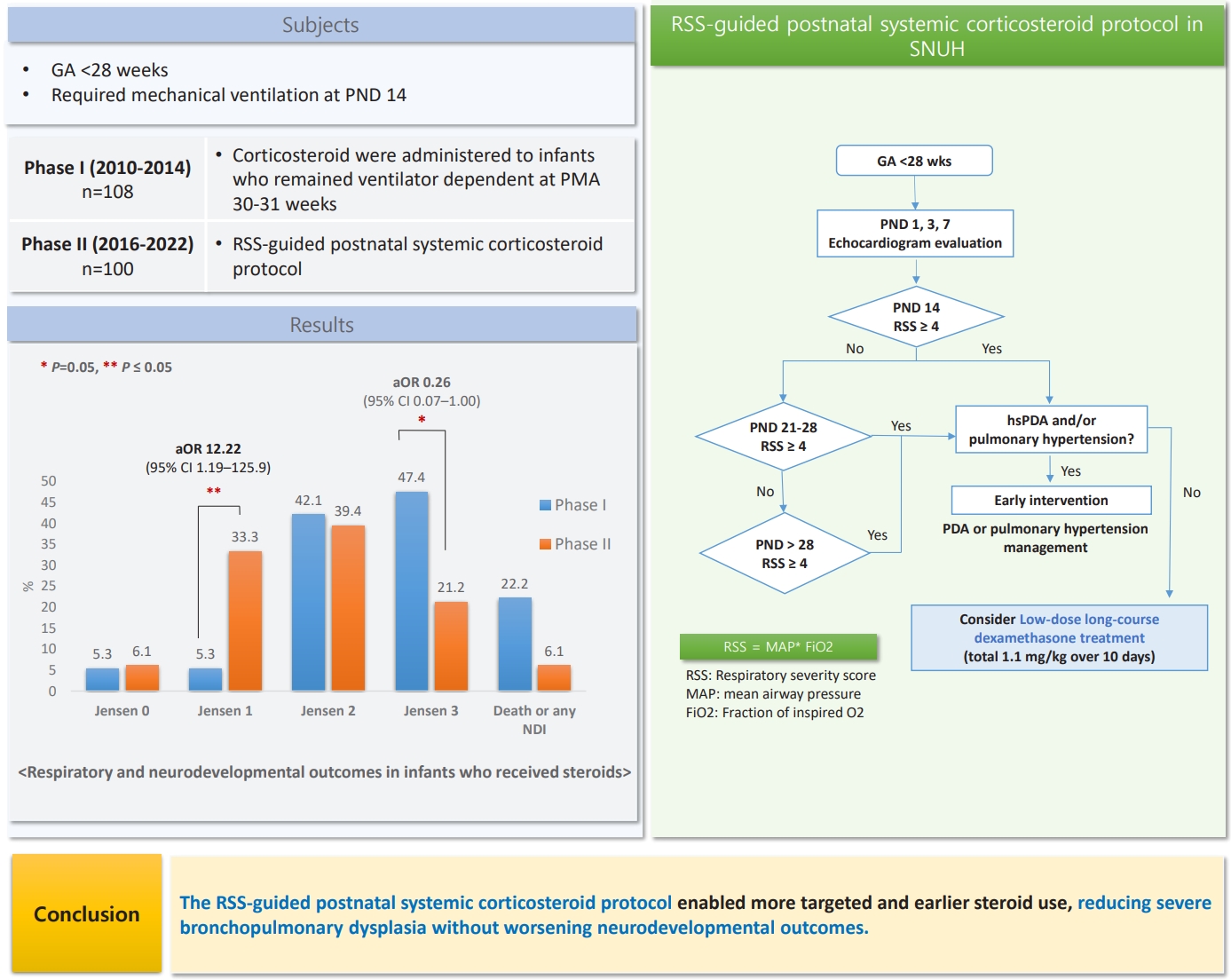
Question: Does a respiratory severity score (RSS)-guided postnatal corticosteroid protocol improve respiratory outcomes of extremely preterm (EP) infants without worsening neurodevelopmental outcomes?
Finding: The protocol enabled targeted and early steroid use, thereby reducing severe bronchopulmonary dysplasia without affecting mortality or causing neurodevelopmental impairments.
Meaning: The RSS-guided protocol may offer a more precise and individualized postnatal corticosteroid therapy for EP infants. |
-
-
- Review Article
- Neurology
- Promising candidate cerebrospinal fluid biomarkers of seizure disorder, infection, inflammation, tumor, and traumatic brain injury in pediatric patients
-
Seh Hyun Kim, Soo Ahn Chae
-
Clin Exp Pediatr. 2022;65(2):56-64. Published online August 23, 2021
-
|
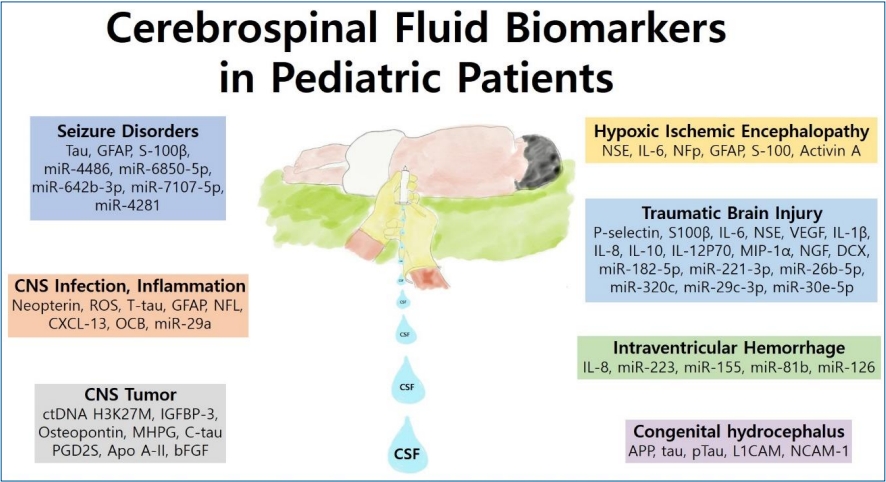
· Pediatric cerebrospinal fluid (CSF) components have been extensively evaluated as biomarkers of various neurologic diseases.
· Several promising candidate CSF biomarkers, including Tau, glial fibrillary acidic protein, neuron-specific enolase, S100β, and interleukins, have been studied in pediatric patients with seizure disorders, central nervous system infections, inflammation, tumors, hypoxic-ischemic encephalopathy, traumatic brain injuries, intraventricular hemorrhage, and congenital hydrocephalus.
· Circulating microRNAs in the CSF are a promising class of biomarkers for various neurological diseases. |
-
-
- Original Article
- Neuroprotective effects of mild hypoxia in organotypic hippocampal slice cultures
-
Seh Hyun Kim, Woo Soon Lee, Na Mi Lee, Soo Ahn Chae, Sin Weon Yun
-
Clin Exp Pediatr. 2015;58(4):142-147. Published online April 22, 2015
-
|
|
Purpose The aim of this study was to investigate the potential effects of mild hypoxia in the mature and immature brain. MethodsWe prepared organotypic slice cultures of the hippocampus and used hippocampal tissue cultures at 7 and 14 days in vitro (DIV) to represent the immature and mature brain, respectively. Tissue cultures were exposed to 10% oxygen for 60 minutes. Twenty-four hours... |
-
-
|