- Original Article
- Infection
- Clinical and laboratory profiles of hospitalized children with acute respiratory virus infection
-
Eunjin Choi, Kee-Soo Ha, Dae Jin Song, Jung Hwa Lee, Kwang Chul Lee
-
Clin Exp Pediatr. 2018;61(6):180-186. Published online June 25, 2018
-

|
Purpose Despite the availability of molecular methods, identification of the causative virus in children with acute respiratory infections (ARIs) has proven difficult as the same viruses are often detected in asymptomatic children. MethodsMultiplex reverse transcription polymerase chain reaction assays were performed to detect 15 common respiratory viruses in children under 15 years of age who were hospitalized with ARI between January 2013... |
-
-
- Review Article
- Pulmonology
- Mechanism of resistance acquisition and treatment of macrolide-resistant Mycoplasma pneumoniae pneumonia in children
-
Hyeon-Jong Yang, Dae Jin Song, Jung Yeon Shim
-
Clin Exp Pediatr. 2017;60(6):167-174. Published online June 22, 2017
-
|
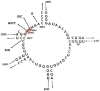
Mycoplasma pneumoniae pneumonia (MPP) is one of the most common forms of community-acquired pneumonia in children and adolescents. Outbreaks of MPP occur in 3- to 7-year cycles worldwide; recent epidemics in Korea occurred in 2006–2007, 2011, and 2015–2016. Although MPP is known to be a mild, self-limiting disease with a good response to macrolides, it can also progress into a... |
-
-
- Allergy
- Rhinovirus and childhood asthma: an update
-
Dae Jin Song
-
Clin Exp Pediatr. 2016;59(11):432-439. Published online November 18, 2016
-
|
|
Asthma is recognized as a complex disease resulting from interactions between multiple genetic and environmental factors. Accumulating evidence suggests that respiratory viral infections in early life constitute a major environmental risk factor for the development of childhood asthma. Respiratory viral infections have also been recognized as the most common cause of asthma exacerbation. The advent of molecular diagnostics to detect... |
-
-
- Original Article
- Predictive value of C-reactive protein in response to macrolides in children with macrolide-resistant Mycoplasma pneumoniae pneumonia
-
Young Ho Seo, Jang Su Kim, Sung Chul Seo, Won Hee Seo, Young Yoo, Dae Jin Song, Ji Tae Choung
-
Clin Exp Pediatr. 2014;57(4):186-192. Published online April 30, 2014
-
|
|
Purpose The prevalence of macrolide-resistant Mycoplasma pneumoniae (MRMP) has increased worldwide. The aim of this study was to estimate the proportion of MRMP in a tertiary hospital in Korea, and to find potential laboratory markers that could be used to predict the efficacy of macrolides in children with MRMP pneumonia. MethodsA total of 95 patients with M. pneumoniae pneumonia were enrolled in... |
-
-
- Association between cord blood 25-hydroxyvitamin D concentrations and respiratory tract infections in the first 6 months of age in a Korean population: a birth cohort study (COCOA)
-
Youn Ho Shin, Jinho Yu, Kyung Won Kim, Kangmo Ahn, Seo-Ah Hong, Eun Lee, Song-I Yang, Young-Ho Jung, Hyung Young Kim, Ju-Hee Seo, Ji-Won Kwon, Byoung-Ju Kim, Hyo-Bin Kim, Jung Yeon Shim, Woo Kyung Kim, Dae Jin Song, So-Yeon Lee, Soo Young Lee, Gwang Cheon Jang, Dong In Suh, Hyeon-Jong Yang, Bong Sung Kim, Suk-Joo Choi, Soo-Young Oh, Ja-Young Kwon, Kyung-Ju Lee, Hee Jin Park, Pil Ryang Lee, Hye-Sung Won, Soo-Jong Hong
-
Clin Exp Pediatr. 2013;56(10):439-445. Published online October 31, 2013
-
|
|
Purpose Previous studies suggest that the concentration of 25-hydroxyvitamin D [25(OH)D] in cord blood may show an inverse association with respiratory tract infections (RTI) during childhood. The aim of the present study was to examine the influence of 25(OH)D concentrations in cord blood on infant RTI in a Korean birth cohort. MethodsThe levels of 25(OH)D in cord blood obtained from 525 Korean... |
-
-
- Review Article
- Environmental tobacco smoke and childhood asthma
-
Dae Jin Song
-
Clin Exp Pediatr. 2010;53(2):121-128. Published online February 15, 2010
-
|
|
In recent years, environmental tobacco smoke (ETS) has become an important worldwide public health issue. Children are particularly vulnerable to ETS because they are still developing. ETS exposure causes a wide range of adverse health effects on childhood asthma. There is convincing evidence that ETS exposure is causally associated with an increased prevalence of asthma, increased severity of asthma and... |
-
-
- Case Report
- A case of Kikuchi's disease with skin involvement
-
Ji Min Jang, Chul Hee Woo, Jung Woo Choi, Dae Jin Song, Young Yoo, Kwang Chul Lee, Chang Sung Son
-
Clin Exp Pediatr. 2006;49(1):103-106. Published online January 15, 2006
-
|
|
Histiocytic necrotizing lymphadenitis, which is also commonly referred to as Kikuchi's disease (KD), is a self-limiting disease of unknown etiology. It affects individuals of all ages, although it is usually seen in young women. However, only a few descriptions of this disease are available in the pediatric literature. KD is clinically characterized by cervical lymphadenopathy, high fever, myalgia, neutropenia and,... |
-
-
- A Case of Measles Encephalopathy with Thalamic Lesion on
Magnetic Resonance Imaging
-
Dae Hun Pee, Dae Jin Song, Young Kyoo Shin, Jung Hwa Lee, Kee Hyoung Lee, Baik Lin Eun, Sang Hoon Cha
-
Clin Exp Pediatr. 2001;44(8):936-941. Published online August 15, 2001
-
|
|
We experienced a case of measles encephalopathy with thalamic lesion on magnetic resonance imaging(MRI) in a 12 year old boy. Measles symptoms such as fever, erythematous maculopapular rashes on whole body and cough with sputum appeared 4 days before neurologic signs such as agitation and drowsy-to-confused mentality. He showed remarkable motor dysfunction without evidence of sensory loss. MRI showed bilateral... |
-
-
|