- Original Article
- Neonatology (Perinatology)
- Respiratory severity score-guided postnatal systemic corticosteroid therapy for bronchopulmonary dysplasia in extremely preterm infants
-
Gyeong Eun Yeom, Ju Sun Heo, Baek Sup Shin, Seh Hyun Kim, Seung Han Shin, Ee-Kyung Kim, Han-Suk Kim
-
Clin Exp Pediatr. 2025;68(9):656-665. Published online July 8, 2025
-
|
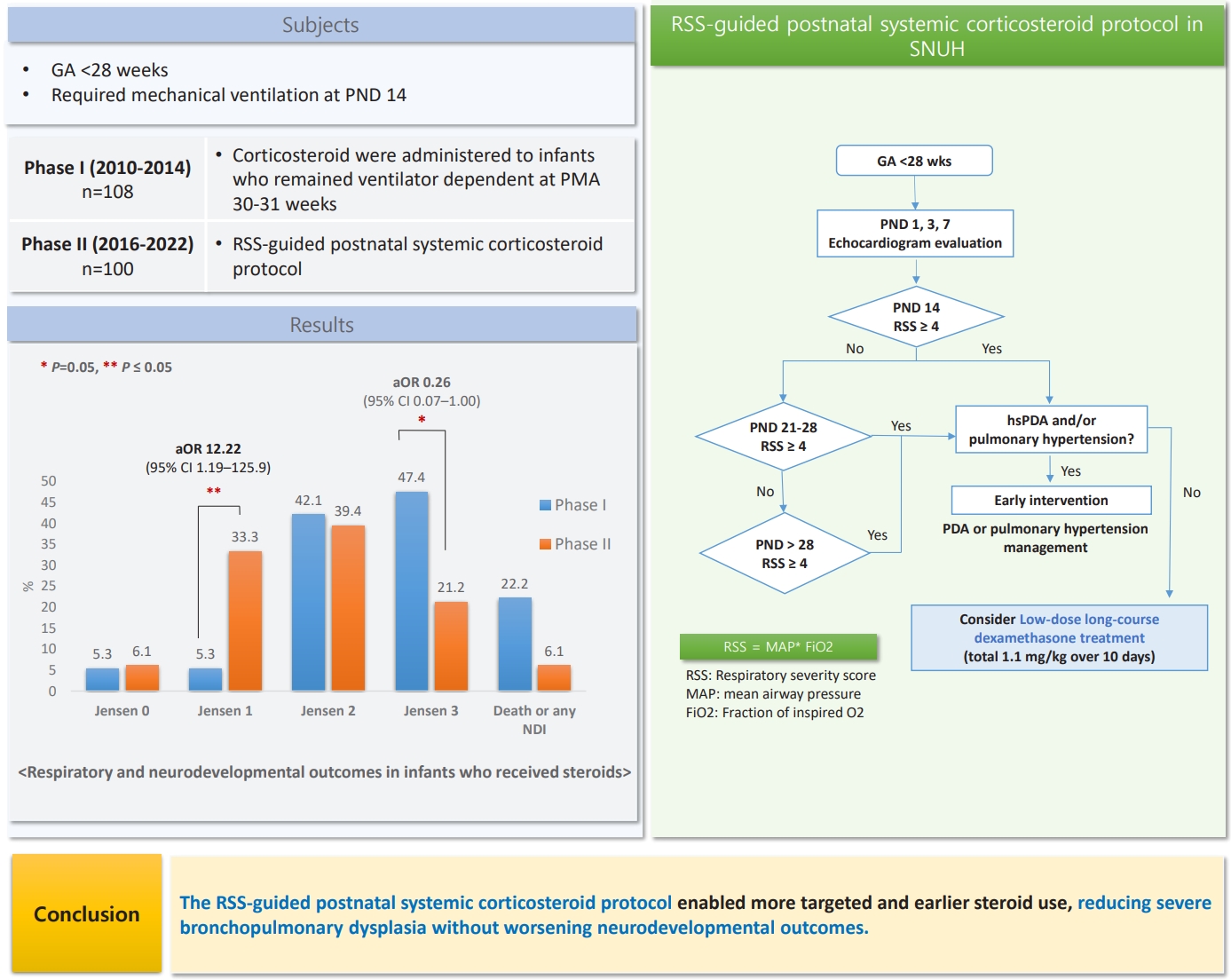
Question: Does a respiratory severity score (RSS)-guided postnatal corticosteroid protocol improve respiratory outcomes of extremely preterm (EP) infants without worsening neurodevelopmental outcomes?
Finding: The protocol enabled targeted and early steroid use, thereby reducing severe bronchopulmonary dysplasia without affecting mortality or causing neurodevelopmental impairments.
Meaning: The RSS-guided protocol may offer a more precise and individualized postnatal corticosteroid therapy for EP infants. |
-
-
- Review Article
- Nutrition
- The Korea Infant Physical Growth Examination Survey (KIPGroS): a study protocol
-
Jong Woo Hahn, MinSoo Shin, Jin Gyu Lim, Yoon-Joo Kim, Ki Soo Kang, Narae Lee, Seong Hee Jeong, Mun Hui Jeong, Yeoun Joo Lee, Eui Kyung Choi, Jung Ok Shim, Jee Yoon Park, Chan-Wook Park, Joo Young Kim, Su Jin Jeong, Young Hwa Jung, Jaehyun Kim, Chang Won Choi, Ju Whi Kim, Seung Han Shin, Yun Jeong Lee, Young Ah Lee, Choong-Ho Shin, Seung-sik Hwang, Young Eun Kim, Youn Ha Kang, Kyungwon Oh, Sungha Yun, Jae Sung Ko, Jin Soo Moon
-
Clin Exp Pediatr. 2025;68(5):352-358. Published online February 13, 2025
-
|
|
The suitability of World Health Organization (WHO) growth charts for assessing the growth of children under 3 years of age in all countries remains controversial, and their applicability must be evaluated based on country-specific growth data. The Korea Infant Physical Growth Examination Survey evaluated the suitability of WHO growth charts to contribute to the next revision of growth charts in Korea. |
-
-
- Original Article
- Neonatology (Perinatology)
- New modified version of the Risk Adjustment for Congenital Heart Surgery category and mortality in premature infants with critical congenital heart disease
-
Young Mi Yoon, Seong Phil Bae, Yoon-Joo Kim, Jae Gun Kwak, Woong-Han Kim, Mi Kyoung Song, Seung Han Shin, Ee-Kyung Kim, Han-Suk Kim
-
Clin Exp Pediatr. 2020;63(10):395-401. Published online July 15, 2020
-
|
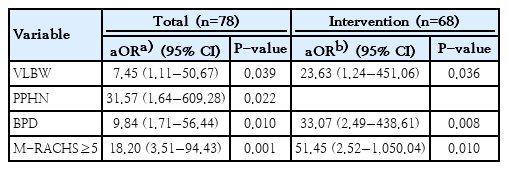
Questions: This study aimed to describe the survival of premature infants with critical congenital heart disease (CHD) and to identify the risk factors including the new modified version of the Risk Adjustment for Congenital Heart Surgery (M-RACHS) associated with mortality.
Finding: For premature infants with critical CHD, survival rate was 76.9% and very low birth weight (VLBW), persistent pulmonary hypertension of the newborn (PPHN), bronchopulmonary dysplasia (BPD), and M-RACHS 5 or more were associated with in-hospital mortality.
Meaning: VLBW, PPHN and BPD, as well as M-RACHS≥5, were risk factors for mortality among premature infants with critical CHD. |
-
-
- The efficacy and safety of Montelukast sodium in the prevention of bronchopulmonary dysplasia
-
Sang Bum Kim, Jang Hoon Lee, Juyoung Lee, Seung Han Shin, Ho Sun Eun, Soon Min Lee, Jin A Sohn, Han Suk Kim, Byung Min Choi, Min Soo Park, Kook In Park, Ran Namgung, Moon Sung Park
-
Clin Exp Pediatr. 2015;58(9):347-353. Published online September 21, 2015
-
|
|
Purpose The purpose of this study was to evaluate the efficacy and safety of Montelukast sodium in the prevention of bronchopulmonarydysplasia (BPD). MethodsThe Interventional study was designed as a multicenter, prospective, and randomized trial, with open labeled and parallel-experimental groups, 66 infants were enrolled and allocated to either the case group (n=30) or the control group (n=36) based on gestational age (GA).... |
-
-
- Case Report
- A case of mucolipidosis II presenting with prenatal skeletal dysplasia and severe secondary hyperparathyroidism at birth
-
Ju Sun Heo, Ka Young Choi, Se Hyoung Sohn, Curie Kim, Yoon Joo Kim, Seung Han Shin, Jae Myung Lee, Juyoung Lee, Jin A Sohn, Byung Chan Lim, Jin A Lee, Chang Won Choi, Ee-Kyung Kim, Han-Suk Kim, Beyong Il Kim, Jung-Hwan Choi
-
Clin Exp Pediatr. 2012;55(11):438-444. Published online November 23, 2012
-
|
|
Mucolipidosis II (ML II) or inclusion cell disease (I-cell disease) is a rarely occurring autosomal recessive lysosomal enzyme-targeting disease. This disease is usually found to occur in individuals aged between 6 and 12 months, with a clinical phenotype resembling that of Hurler syndrome and radiological findings resembling those of dysostosis multiplex. However, we encountered a rare case of an infant... |
-
-
- A case of congenital vallecular cyst associated with
gastroesophageal reflux presenting with stridor,
feeding cyanosis, and failure to thrive
-
Mi Ae Yang, Min Jae Kang, Jeana Hong, Seung Han Shin, Sang Duk Kim, Ee-Kyung Kim, Han-Suk Kim, Jung-Hwan Choi, Tack Kyun Kwon, In-One Kim
-
Clin Exp Pediatr. 2008;51(7):775-779. Published online July 15, 2008
-
|
|
Vallecular cyst is an uncommon but potentially dangerous condition causing stridor and has been associated with sudden airway obstruction resulting in death due to its anatomical location in neonates. It may also present with various degrees of feeding problems resulting in failure to thrive. When a vallecular cyst is suspected clinically, endoscopic laryngoscopy is necessary to visualize it. Other conditions... |
-
-
- Original Article
- Clinical characteristics of severe respiratory syncytial virus infection
requiring mechanical ventilation in neonatal period and early infancy
-
Seung Han Shin, Jae Ri Kim, Jin-A Lee, Chang Won Choi, Ee-Kyung Kim, Eun Hwa Choi, Han-Suk Kim, Beyong Il Kim, Hoan Jong Lee, Jung-Hwan Choi
-
Clin Exp Pediatr. 2008;51(4):372-376. Published online April 15, 2008
-
|
|
Purpose : To identify clinical characteristics of severe respiratory syncytial virus (RSV) in neonatal period and early infancy and provide information in clinical practice.
Methods : Twelve neonates and young infants (<6 months) who were infected by respiratory syncytial virus and required mechanical ventilation between March 2005 and July 2007 were enrolled. Diagnosis of RSV infection was made based on the... |
-
-
|