- Original Article
- Hematology
- Outcomes of hematopoietic stem cell transplantation for pediatric patients with transfusion-dependent thalassemia in Thailand
-
Kleebsabai Sanpakit, Kamala Laohverapanich, Bunchoo Pongtanakul, Nattee Narkbunnam, Chayamon Takpradit, Usanarat Anurathapan, Samart Pakakasama, Supanun Lauhasurayotin, Kanhatai Chiengthong, Thirachit Chotsampancharoen, Pornpun Sripornsawan, Piya Rujkijyanont, Duantida Songdej, Nongnuch Sirachainan, Suradej Hongeng
-
Clin Exp Pediatr. 2026;69(4):340-352. Published online March 13, 2026
-
|
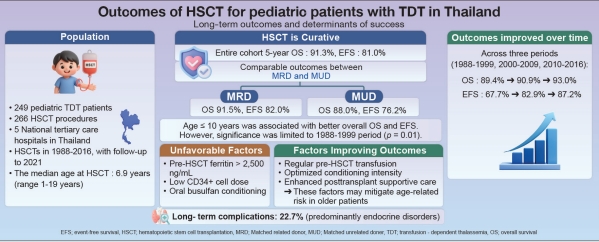
Question: Can hematopoietic stem cell transplantation (HSCT) cure pediatric transfusion-dependent thalassemia in Thailand? What influences its outcomes?
Finding: Among 266 HSCT procedures, 5-year overall survival and event-free survival rates were 91.3% and 81.0%, respectively. Outcomes were comparable between related and unrelated donors. Pre-HSCT ferritin >2,500 ng/mL, low CD34+ cell dose, and oral busulfan conditioning were associated with unfavorable survival. Longterm complications affected 22.7% of survivors.
Meaning: Optimizing pre-HSCT care, ensuring adequate grafting, and long-term surveillance are crucial. |
-
-
- Granulocyte transfusion improves survival in pediatric febrile neutropenia: a 15-year cohort study
-
Witsanu Phetsai, Kleebsabai Sanpakit, Jassada Buaboonnam, Kamon Phuakpet, Nassawee Vathana, Nattee Narkbunnam, Fon Kladed, Chayamon Takpradit
-
Clin Exp Pediatr. 2026;69(3):236-246. Published online January 12, 2026
-

|
Question: Does granulocyte transfusion improve survival and clinical recovery in pediatric febrile neutropenia?
Finding: In this 15-year real-world cohort, granulocyte transfusion significantly increased 30-day survival (92.3 % vs. 65.4%; adjusted odds ratio, 0.105; P=0.020) and accelerated fever and neutrophil recovery without serious adverse events.
Meaning: Granulocyte transfusion may be an effective adjunctive therapy for severe neutropenic infections in children, particularly in low- and middle-income settings. |
-
-
- Oncology
- Treatment outcomes of high-dose chemotherapy plus stem cell rescue in high-risk neuroblastoma patients in Thailand
-
Kunanya Suwannaying, Piti Techavichit, Patcharee Komvilaisak, Napat Laoaroon, Nattee Narkbunnam, Kleebsabai Sanpakit, Kanhatai Chiengthong, Thirachit Chotsampancharoen, Lalita Sathitsamitphong, Chalongpon Santong, Panya Seksarn, Suradej Hongeng, Surapon Wiangnon
-
Clin Exp Pediatr. 2022;65(9):453-458. Published online May 24, 2022
-

|
Question: This study aimed to elucidate the outcomes of high-risk neuroblastoma (HR-NB) patients treated with high-dose chemotherapy and stem cell rescue without immunotherapy.
Finding: The 5-year overall survival and event-free survival rates were 45.1% and 40.4%, respectively.
Meaning: High-dose chemotherapy plus stem cell rescue followed by cis-retinoic acid for 12 months is well tolerated and could improve survival in patients with HR-NB in limited resource settings. |
-
-
|