
Search

  • HOME
  • Search
Original Article
Gastroenterology
Distinct age-dependent phenotypes of abnormal liver function tests derived from national Emergency Department data
Dong-Uk Kim, Shinjie Choi, Yeji Kim, Lia Kim, Jung Ok Shim, Jin Soo Moon, Jong Woo Hahn, Hye Ran Yang, Ju Young Chang, Jae Sung Ko
Clin Exp Pediatr. 2026;69(7):563-571.   Published online May 14, 2026
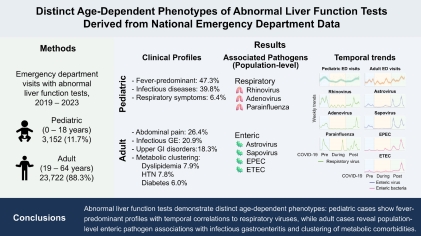
Question: What are the clinical phenotypes and pathogen associations of pediatric and adult Emergency Department visits for abnormal liver function tests?
Finding: Pediatric visits showed fever-predominant profiles with temporal correlations with respiratory viruses, whereas adult visits revealed population-level temporal associations between enteric pathogens and infectious gastroenteritis, upper gastrointestinal disorders, and metabolic comorbidity clustering.
Meaning: These findings provide novel population-level evidence of age-specific pathogen associations and support distinct age-stratified clinical diagnostics.
Emergency Medicine
A nationwide study of children and adolescents with pneumonia who visited Emergency Department in South Korea in 2012
Chang Hyu Lee, Youn Kyoung Won, Eui-Jung Roh, Dong In Suh, Eun Hee Chung
Clin Exp Pediatr. 2016;59(3):132-138.   Published online March 31, 2016
Purpose

Acute respiratory infection, particularly pneumonia, is the most common cause of hospitalization and death among children in developing nations. This study aimed to investigate the characteristics of children and adolescents with pneumonia who visited Emergency Department (ED) in South Korea in 2012.

Methods

We analyzed National Emergency Department Information System (NEDIS) records from 146 EDs in South Korea for all pediatric patients...

Parental satisfaction with pediatric emergency care: a nationwide, cross-sectional survey in Korea
Hye Young Jang, Young Ho Kwak, Ju Ok Park, Do Kyun Kim, Jin Hee Lee
Clin Exp Pediatr. 2015;58(12):466-471.   Published online December 22, 2015
Purpose

This study attempted to examine parental satisfaction with pediatric emergency care (PEC) in Korea and investigate the features influencing overall satisfaction.

Methods

A nationwide, cross-sectional survey was conducted among parents who had taken their children to an Emergency Department (ED) in the three years prior to the study. A 21-item, structured questionnaire was administered to the parents through a web-based system. Participants'...

Review Article
Regionalization of pediatric emergency care in Korea
Do Kyun Kim
Clin Exp Pediatr. 2011;54(12):477-480.   Published online December 31, 2011

In order to care for an ill or injured child, it is crucial that every emergency department (ED) has a minimum set of personnel and resources because the majority of children are brought to the geographically nearest ED. In addition to adequate preparation for basic pediatric emergency care, a comprehensive, specialized healthcare system should be in place for a critically-ill...

Original Article
Clinical analysis of febrile infants and children presenting to the pediatric emergency department
Byeong Gon Kwak, Hyun Oh Jang
Clin Exp Pediatr. 2006;49(8):839-844.   Published online August 15, 2006
Purpose : We studied clinical patterns of the febrile infants and children presenting to the Pediatric Emergency Department(ED) in the general pediatric population. Method : We analyzed 1,764 infants and children who had a history of measured body temperature of 38.3℃ or higher, before or after arrival at Pediatric ED of Ilsan Paik Hospital from September 2004 to August 2005....


TOPICS

Browse all articles >

ARTICLE CATEGORY

Browse all articles >

BROWSE ARTICLES
FOR CONTRIBUTORS
ABOUT
Editorial Office
Korean Pediatric Society
#1606 Seocho World Officetel, 19 Seoun-ro, Seocho-ku, Seoul 06732, Korea
Tel: +82-2-3473-7306    Fax: +82-2-3473-7307    E-mail: office@e-cep.org                

Clinical and Experimental Pediatrics is an open access journal. All articles are distributed under the terms of the Creative Commons Attribution NonCommercial License (http://creativecommons.org/licenses/by-nc/4.0/)

Copyright © 2026 by Korean Pediatric Society.      Developed in M2PI