First biallelic CASQ2 variant in a Korean child with catecholaminergic polymorphic ventricular tachycardia
Article information

Catecholaminergic polymorphic ventricular tachycardia (CPVT) is a rare, life-threatening, inherited arrhythmia syndrome characterized by adrenergically stimulated ventricular tachyarrhythmias that cause syncope and sudden cardiac death [1]. While most cases result from autosomal dominant variants of the cardiac ryanodine receptor (RYR2) gene, approximately 2%–5% involve homozygous or compound heterozygous variants of the cardiac calsequestrin (CASQ2) gene [2]. CASQ2-mediated CPVT often presents a more malignant clinical course, including earlier onset and significant sinus node dysfunction [3,4]. To the best of our knowledge, this is the first Korean CASQ2-mediated CPVT case where sleep disturbances uniquely aggravated malignant arrhythmias requiring an implantable cardioverter-defibrillator (ICD) for refractory arrhythmias and severe drug-induced bradycardia.
An 8-year-old girl with no relevant family history presented with exertional syncope. Electrocardiography revealed sinus bradycardia (57 bpm) and normal QTc, and echocardiography confirmed a structurally normal heart. Holter monitoring revealed bidirectional ventricular tachycardia (VT) associated with reported chest discomfort. Treadmill testing induced nonsustained bidirectional VT at stage 3 (Fig. 1), confirming the CPVT diagnosis. The initial nadolol dose (15 mg) was decreased to 10 mg for bradycardia-related chest tightness and dizziness, and then switched to propranolol for recurrent exertional syncope. Escalating beta-blockers to control VT-induced syncope exacerbated bradycardia-related symptoms (sleep disturbance, constipation, and abdominal pain), causing noncompliance and worsening syncope. Addition of flecainide did not alter this pattern; therefore, left cardiac sympathetic denervation (LCSD) was performed at 9 years of age.
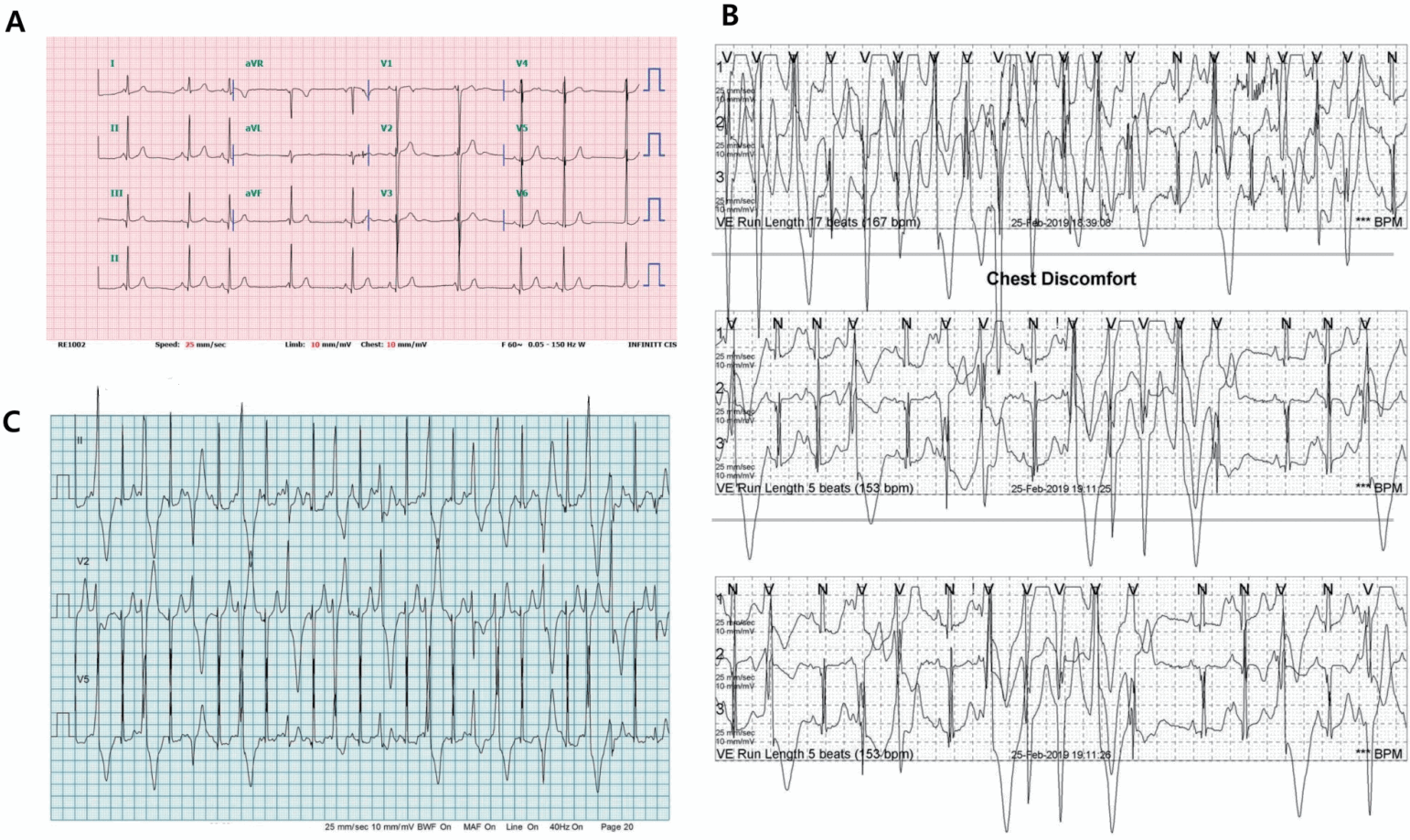
(A) Baseline 12-lead electrocardiogram demonstrating sinus bradycardia (57 bpm). (B) Bidirectional ventricular tachycardia observed during 24-hour Holter monitoring associated with reported chest discomfort. (C) Treadmill exercise stress test showing asymptomatic nonsustained bidirectional ventricular tachycardia induced at stage 3.
Post-LCSD, the premature ventricular contraction (PVC) heart rate (HR) threshold increased from 108 to 120 bpm. Notably, bidirectional PVCs previously observed at 130 bpm were completely suppressed after the procedure. During adolescence, the patient experienced frequent headaches, dizziness, and insomnia. Worsening insomnia and circadian rhythm disruption increased VT-related syncope. Medication-exacerbated dizziness prompted frequent self-discontinuation. Sleep actigraphy confirmed irregular sleep onset (midnight to 7:00 AM). Concurrently, serial treadmill testing demonstrated a progressively lower HR threshold for PVCs (110 to 83 bpm). To regulate circadian rhythms, melatonin (2 mg) was administered at age 11. Actigraphy confirmed corrected sleep onset before midnight, with reduced syncope and a temporarily improved quality of life. However, symptomatic bradycardia perpetuated poor patient compliance, causing recurrent syncope.
To prevent fatal ventricular fibrillation (VF), a dual-chamber ICD was implanted at the age of 14 years according to European Society of Cardiology Class IIa recommendation [5]. Pacing at 60 bpm (AAIR↔DDDR mode) controlled bradycardia-related symptoms, improving compliance and stabilizing her condition without further syncope on nadolol 40 mg daily (Fig. 2).
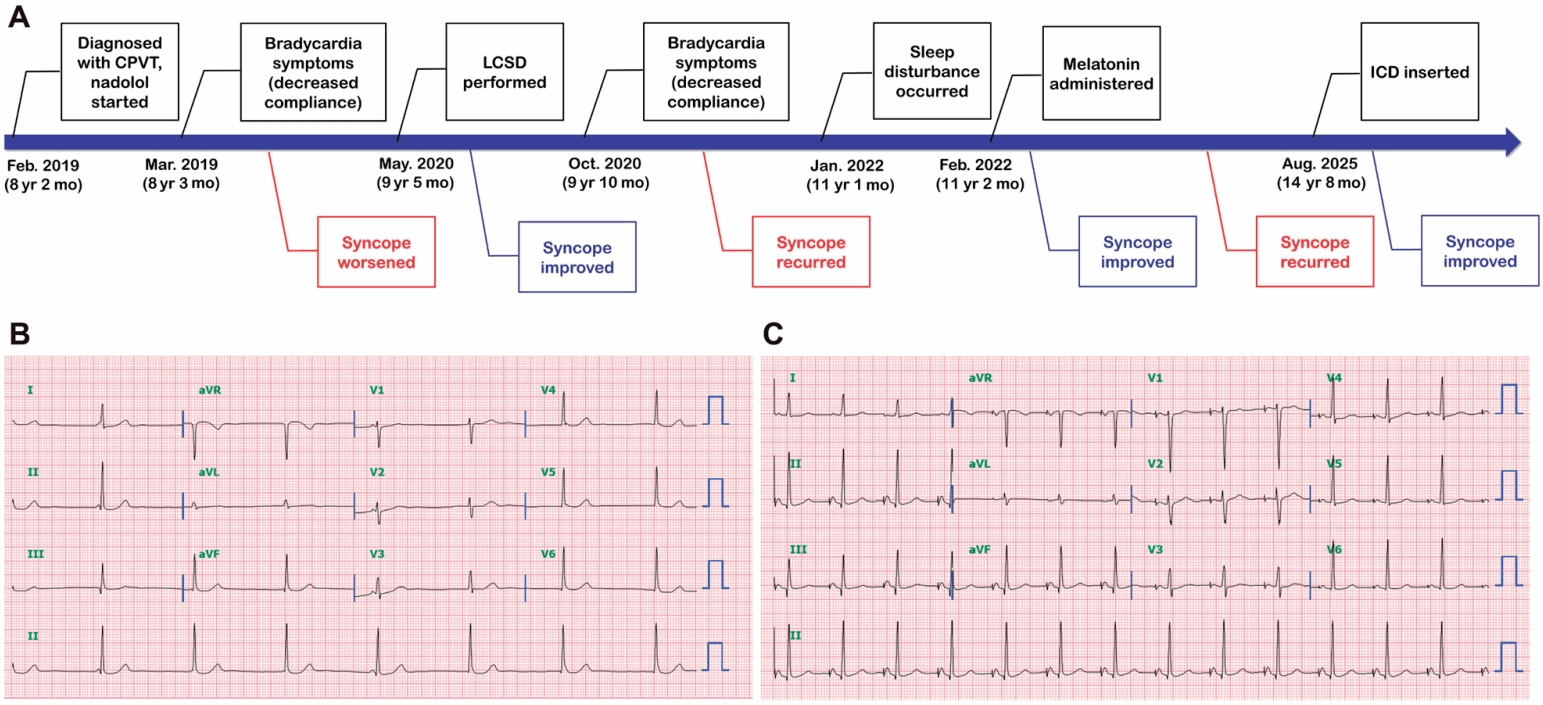
(A) Timeline of the patient's clinical course illustrating recurrent syncope and bradycardia refractory to pharmacological therapy as well as left cardiac sympathetic denervation. (B) Follow-up electrocardiogram showing severe bradycardia (45 bpm) and a junctional escape rhythm (taken December 01, 2024). (C) Postprocedural electrocardiogram following implanted cardioverter-defibrillator implantation demonstrating atrial pacing at 60 bpm (taken August 21, 2025). CPVT, catecholaminergic polymorphic ventricular tachycardia; LCSD, left cardiac sympathetic denervation; ICD, implantable cardioverter-defibrillator.
Genetic analysis revealed a novel biallelic nonsense CASQ2 variant (c.220G>T, p.(Glu74*)). Family screening revealed an asymptomatic heterozygous father (T/WT) and variant-free mother (WT/WT).
Given its definitive phenotype, the CASQ2 variant is likely to be disease-causing [6]. Although heterozygotes occasionally exhibit mild proarrhythmic phenotypes, CASQ2-mediated CPVT is fundamentally an autosomal recessive disease manifesting in homozygotes [3,7]. Her apparent homozygosity suggests maternal exon deletion, paternal uniparental isodisomy, or polymerase chain reaction allele dropout. Confirmatory testing, such as multiplex ligation-dependent probe amplification or short tandem repeat analysis, was not feasible. In nonconsanguineous populations, such as in Korea, these nontraditional inheritance mechanisms represent a crucial pathway for autosomal recessive conditions.
Clinically, sleep disturbances strikingly exacerbated syncopal symptoms. We hypothesize that they elevated baseline catecholamines rather than acting as direct triggers. Evidence suggests that sleep deprivation lowers the VT-triggering threshold by increasing the baseline catecholamine levels and HR during exertion [8]. Beyond its hypnotic effects, melatonin likely restored the circadian clock and normalized the nocturnal sympathetic tone, resolving chronic hyperarousal and suppressing daytime catecholamine surges. Although natural disease fluctuations or unmeasured lifestyle adjustments cannot be entirely excluded, the distinct reduction in syncope following melatonin-mediated sleep correction strongly suggests that sleep disturbance is a modifiable exacerbating factor. Consistent with this, patients with CPVT exhibit higher afternoon and evening ventricular arrhythmia frequencies, implying arrhythmogenic factors beyond exercise-induced surges [9]. This case emphasizes the clinical value of identifying individual contributing factors such as altered circadian rhythms, along with traditional exercise restrictions.
The coexistence of intrinsic and drug-induced bradycardia, which reduces patient compliance, is well-documented in RYR2-related CPVT [10]. Recent CASQ2 deletion studies have suggested that loss of function increases spontaneous calcium release while causing sinus node fibrosis and calcium cycling dysfunction [4]. Her low resting HR suggested that intrinsic sinus node dysfunction aggravated drug-induced bradycardia. Many patients with CPVT exhibit poor medication adherence owing to bradycardia, fatigue, or dizziness, directly linking nonadherence to life-threatening breakthrough arrhythmias [10]. ICD implantation in CPVT is generally controversial because of the risk of shock-induced catecholamine storms, and is not indicated solely for pacing [1]. However, our primary indication was life-threatening refractory syncope, despite maximal pharmacological therapy and LCSD. In addition, atrial pacing resolved symptomatic bradycardia, enabling optimal beta-blocker therapy while preventing sudden cardiac death.
In conclusion, to the best of our knowledge, this is the first report of a Korean case of CASQ2-mediated CPVT that provides valuable clinical insights into the malignant features exacerbated by sleep deprivation and drug intolerance.
CASQ2 variants create a therapeutic paradox; life-threatening VT/VF coexists with profound bradycardia, limiting essential antiarrhythmic use. Active pacing is a vital secondary benefit when ICDs are used for refractory syncope. This dual function resolves the therapeutic paradox and offers a practical strategy to ensure pharmacological compliance and arrhythmic stability.
Question
Which of the following is not a common finding of CASQ2-mediated CPVT?
(A) Clinical presentation requires a homozygous genotype.
(B) Patients often exhibit profound resting bradycardia and sinus node dysfunction.
(C) Ventricular arrhythmias are exclusively triggered by high-intensity physical exercise.
(D) It tends to present with a more malignant clinical course compared to RYR2 variants.
Answer: C
Notes
Conflicts of interest
No potential conflict of interest relevant to this article was reported.
Funding
This study received no specific grant from any funding agency in the public, commercial, or not for profit sectors.
Ethics statement
Written informed consent for the publication of clinical details and images was obtained from the patient’s parents.
Author contribution
Conceptualization: JH; Data curation: GJC; Methodology: SHK; Project administration: JYS, JH; Visualization: ISK; Writing - original draft: SHJ; Writing - review & editing: JKY