Telomere biology disorders in childhood interstitial lung disease: new insights from the chILD-EU cohort
Article information

Key message
Greiner-Mai et al. expand recognition of telomere biology disorder (TBD)-associated interstitial lung disease (ILD) in children, demonstrating heterogenous radiographic and ILD subtypes in combination with variable extrapulmonary phenotypes, even in the absence of ultrashort peripheral blood telomere length (TL). While their findings highlight some of the limitations of current TL testing methods, they introduce critical questions regarding family screening and the role of antifibrotic and telomere-directed therapies in children with TBD-related ILD.
Despite being first described in children, the pulmonary manifestations of telomere biology disorders (TBDs) have been better studied in adults with interstitial lung disease (ILD). Between 15%–30% of adults with familial ILD have short telomeres (<10th age adjusted percentile), pathogenic or likely pathogenic telomere maintenance gene variants, or both (Table 1) [1]. In contrast, the association between TBD and childhood ILD has been less well described. In this setting, the cohort study from Greiner-Mai et al. adds a significant international perspective [2]. Using the chILD-EU database, the authors measured telomere length (TL) by quantitative polymerase chain reaction (qPCR) and completed exome sequencing to identify pediatric patients with TBD-related ILD, which they characterized as the presence of a pathogenic variant or variant of unknown significance (VUS), with phenotypic manifestations of a TBD, with or without TL <10th percentile. This inclusive definition captures the complexity of genotype-phenotype relationships in TBDs, including that ultrashort TL can be inherited independently of the causative genetic variant and that TL can be shorter in affected tissues, even if peripheral blood mononuclear cells (PBMC) have TL>10th percentile.
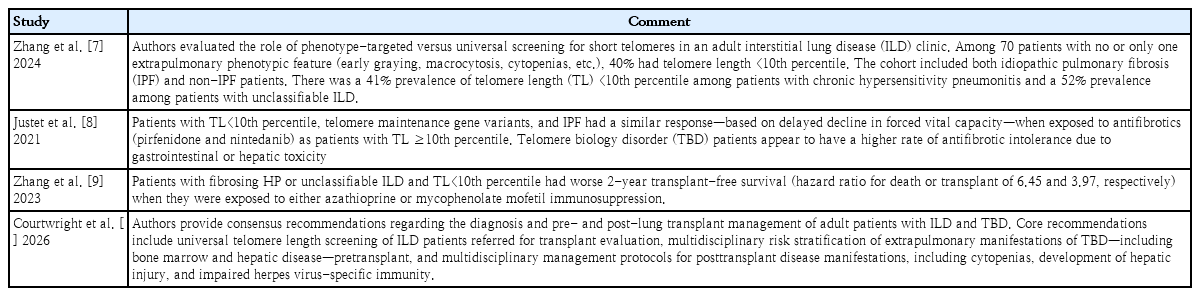
Selected recent publications on telomere biology disorder-related interstitial lung disease in adults
Greiner-Mai et al. [2] identified 10 pediatric patients within chILD-EU with TBD ILD. While the denominator is not reported, given the size of the database presented in other studies, this suggests a 1%–2% prevalence [3]. In contrast to adults with TBD ILD, most patients in the cHILD-EU cohort had multiple extrapulmonary disease manifestations, including classic dyskeratosis congenita findings, bone marrow failure, and/or cirrhosis. While early graying and familial ILD data were not available, at least one patient had only ILD, while another presented with only ILD and failure to thrive. This raises the question of whether TL testing in children with ILD should be targeted based on the presence of other extrapulmonary TBD-related phenotypes, or should be standard screening for any pediatric patient with ILD. As in the adult literature, ILD subtypes were variable, extending beyond usual interstitial pneumonia to nonspecific interstitial pneumonia and pleural fibrosis [1]. The presence of emphysema and cysts in at least a third of patients also speaks to the variety of radiographic presentations.
Two additional findings in this study warrant additional exploration. First, 2 patients had VUS in telomere maintenance genes (TERT and DKC) with characteristic phenotypic manifestations and TL>10th percentile. This may reflect the use of qPCR for TL analysis, given the potential for intra-assay variability. Alternatively, because qPCR measures average TL in all PBMC, it may be that some cell lines in these patients (lymphocytes, granulocytes) had TL<10th percentile. In either case, use of flow-FISH (fluorescence in situ hybridization) to confirm TL testing in individual cell lines would be warranted. If this confirms TL>10th percentile, additional testing could evaluate for somatic rescue of TL in bone marrow progenitor cells [4]. This would account for the appearance of normal PBMC TL but TBD-related ILD. Alternatively, some variants in telomere maintenance genes—APOLLO and POT1—have been associated with very short TL on some chromosomal arms but normal average TL. This has not been reported with TERT and DKC variants, and would represent a novel finding, if born out in assays such as Single Telomere Length Analysis.
Like all good studies, the work from Greiner-Mai et al. [2] raises additional questions. How should physicians and genetic counselors approach screening of phenotypically unaffected siblings and their parents? Genetic testing followed by telomere length measurement or both? And, for the postpubertal children in this cohort, what are the best practice family planning discussions, given that TL can be inherited independently of genetic variants? Finally, what is the appropriate treatment? As the authors note, there is growing evidence from adult TBD ILD patients suggesting that prednisone- or cell-cycle-inhibitor–based immunosuppression, even in nonidiopathic pulmonary fibrosis TBD ILD, may be associated with increased mortality (Table 1). While weight-based nintedanib appears to be well tolerated among children with ILD, the role of next generation antifibrotics, including nerandomilast, remains unexplored [5]. To what extent systemic-telomere elongation directed treatments such as danazol or deoxycytidine and deoxythymidine can slow the progression of TBD-mediated ILD in these young patients, also remains an open question [6].
Notes
Conflicts of interest
No potential conflict of interest relevant to this article was reported.
Funding
This study received no specific grant from any funding agency in the public, commercial, or not-for-profit sectors.